

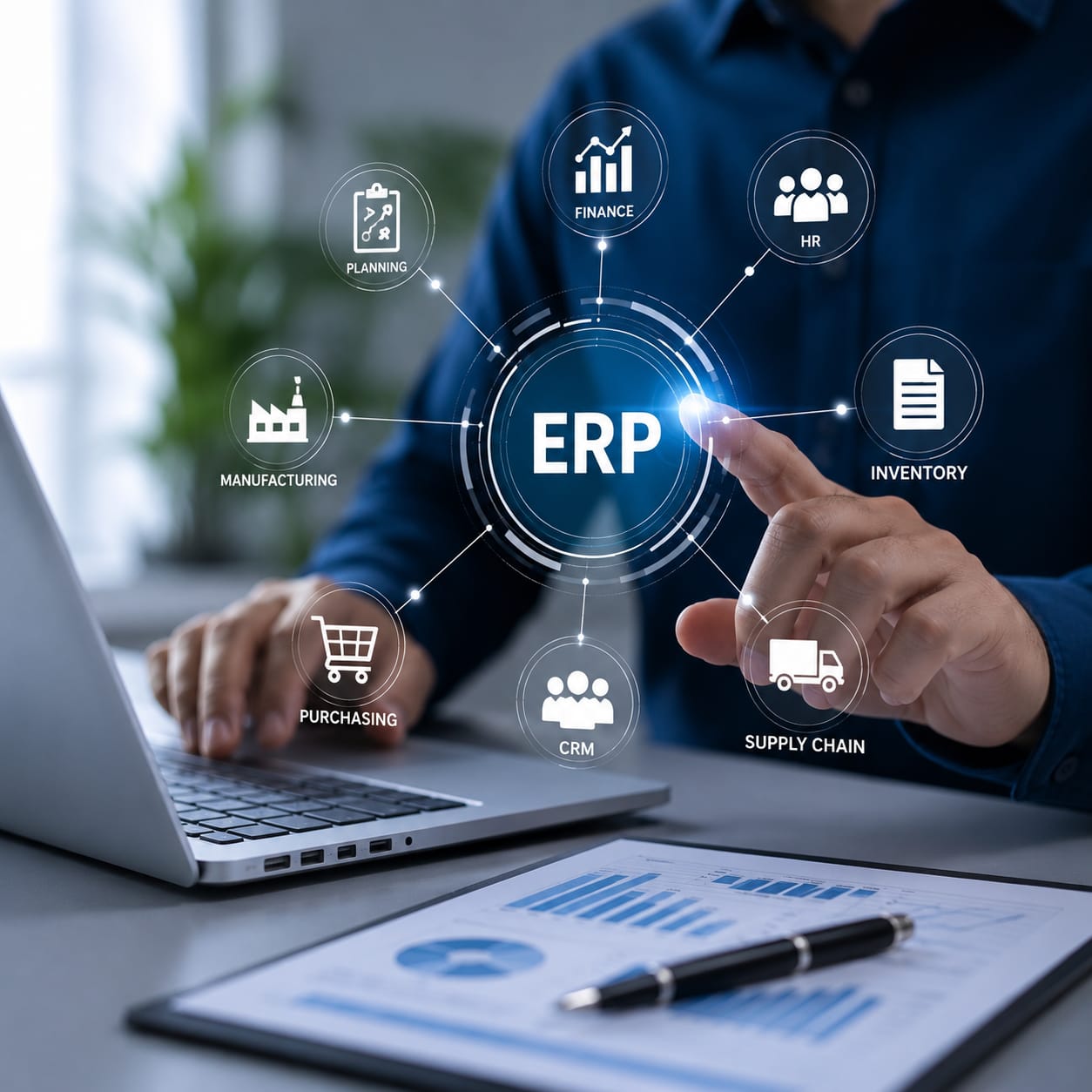
Most businesses shopping for ERP software in UAE markets start by comparing feature lists and pricing tiers, which is a reasonable instinct but the wrong starting point. The businesses that end up genuinely satisfied with their ERP investment usually went through a different process first: an actual assessment of what’s slowing operations down, before anyone talked about specific software at all.
This is really the value a proper ERP consultant brings, and it’s worth understanding what that consulting process should actually involve before committing to any platform.
Not sure where to start with an ERP decision? Book a consultation with Fintegra or call (+971) 58-533-1105.
Why Jumping Straight to Software Selection Backfires
It’s tempting to treat ERP selection like buying any other piece of software, compare features, check pricing, pick the best-reviewed option. The problem is that enterprise resource planning software in UAE businesses needs to actually reflect how that specific business operates, its industry, its compliance obligations, its existing workflows, not just its size or budget.
A business that skips the assessment phase and jumps straight to software selection often ends up with a system that’s technically capable but poorly matched to actual daily operations, requiring expensive customisation later to fix gaps that a proper upfront consultation would have caught from the start.
What a Proper ERP Consulting Engagement Actually Involves
A structured ERP consulting process generally follows a sequence designed to tie every technical decision back to the business’s actual goals, not just its stated feature requirements.
- Operational assessment. Understanding current workflows, pain points, and where time or accuracy is currently being lost across departments.
- Mapping constraints to KPIs. Connecting specific operational problems to the metrics the business actually cares about, whether that’s order fulfilment speed, financial reporting accuracy, or inventory turnover.
- Building a tailored action plan. Translating that assessment into a clear roadmap for what the ERP system needs to solve, in what order, and how success will be measured.
- Solution matching. Only at this stage does the actual software selection happen, matched against the specific requirements identified in the earlier steps rather than a generic feature checklist.
- Implementation and ongoing support. Carrying that same tailored understanding through deployment, training, and post-launch refinement.
Skipping straight to step four without the groundwork in steps one through three is exactly how businesses end up with expensive systems that don’t actually solve their real problems.
ERP and Accounting Software: Why This Module Deserves Extra Scrutiny
For most businesses, the financial module is the part of an ERP system that gets used every single day, by finance teams, by management reviewing reports, and indirectly by every department whose spending or revenue flows through it. Getting ERP and accounting software right matters enormously, since errors or gaps here ripple across the entire organisation’s decision-making.
A properly configured accounting module should provide real-time visibility into revenue, expenses, invoicing, and asset tracking, backed by automated controls rather than manual reconciliation. For UAE businesses specifically, this also means built-in VAT compliance, audit-ready reporting, and bilingual invoicing capability where relevant, configured from the start rather than added as a workaround after go-live.
Supply Chain and Inventory Management: Where Operational Gaps Show Up Fastest
If accounting problems show up in monthly reports, supply chain and inventory problems show up daily, on the warehouse floor, in stockouts, in overordering, in delayed shipments. Supply chain and inventory management software built into a proper ERP platform should give accurate stock visibility, demand forecasting, vendor management, and smart replenishment recommendations, reducing both the delays caused by understocking and the wasted capital tied up in overstocking.
This matters differently depending on industry. A perishable goods business needs tight visibility into shelf life and temperature-sensitive storage. A distribution company needs multi-warehouse stock accuracy. A manufacturing operation needs supply chain visibility tied directly to production scheduling. A generic inventory module that doesn’t account for these industry-specific realities tends to underperform regardless of how sophisticated it looks on paper.
Why Industry-Specific Configuration Changes the Outcome
Fintegra works across a genuinely wide range of sectors, professional services, transportation and logistics, marine, wood and timber, manufacturing, retail, wholesale distribution and trading, hospitality and restaurants, and real estate, and each of these brings distinct operational realities that a one-size-fits-all ERP configuration simply can’t address well.
A retail business needs multi-store inventory and POS integration. A logistics company needs shipment tracking tied directly into financial reporting. A real estate business needs property and lease management integrated with tenant billing. This is why the consulting phase, understanding which of these realities actually applies to your business, matters as much as the software’s underlying capability.
What to Ask an ERP Consultant Before Committing
A few direct questions help separate a consultant genuinely invested in your outcome from one simply trying to sell a specific platform:
- What specific operational problems did your assessment identify, and how does the recommended solution address each one directly?
- How is success measured after implementation, and what KPIs will actually confirm the system is working as intended?
- How does the accounting module handle UAE-specific compliance, VAT reporting, audit trails, bilingual invoicing, specifically?
- What does the supply chain and inventory configuration look like for our specific industry, not just generically described?
- What happens after go-live, is ongoing support and periodic review part of the engagement, or does the relationship end at launch?
A consultant unable to answer these with specifics, rather than general reassurance, likely hasn’t done the assessment work a proper engagement requires.
How Fintegra Approaches ERP Consulting
Fintegra Solutions was established in 2021 specifically to address a gap in how UAE businesses were being sold generic ERP software without proper upfront assessment. The team, made up of industry veterans with more than 100 years of combined experience in digital transformation and business process optimisation, builds every ERP engagement around studying a client’s actual operations first, mapping what’s genuinely holding the business back, and building an action plan that ties every technical decision back to measurable business goals.
This planned, team-based approach carries through from initial consultation into implementation and beyond, covering everything from core ERP and accounting functionality through supply chain and inventory management, tailored to the specific sector each client operates in.
Frequently Asked Questions
1. How long does a proper ERP consulting assessment take before implementation begins?
This varies based on business complexity, but a thorough operational assessment generally takes longer for multi-department or multi-entity businesses than for a smaller, single-location operation, since more workflows and stakeholders need to be reviewed.
2.Can ERP and accounting software really replace a dedicated accounting system entirely?
Yes, a properly configured ERP financial module handles the same core accounting functions as standalone software, revenue tracking, invoicing, reporting, while also connecting that financial data directly to inventory, sales, and operational data across the business.
3.Does supply chain software need to be different for perishable versus non-perishable goods?
Yes, perishable goods businesses need shelf-life tracking, temperature-sensitive storage visibility, and tighter demand forecasting than non-perishable inventory, which is why generic inventory modules often underperform for this specific use case.
4.What’s the real difference between buying ERP software directly and going through a consulting-led process?
Buying software directly means selecting based on features and price without necessarily addressing your specific operational gaps. A consulting-led process starts by identifying those gaps first, which generally results in a better-matched system requiring less costly rework later.
5.Is Fintegra’s ERP consulting suitable for small businesses, or only larger enterprises?
Fintegra works with both growing SMEs and large enterprises, offering scaled solutions like Fintegra ERP-Lite for smaller operations alongside full enterprise deployments for larger, more complex businesses.
6.Does the consulting process continue after the ERP system goes live?
Yes, ongoing support and periodic review are part of a properly structured engagement, since business needs and operational priorities continue evolving well beyond the initial go-live date.
Start With the Right Questions, Not the Right Software
Choosing ERP software in UAE markets starts with understanding your actual operational gaps, not comparing feature lists in isolation. Fintegra Solutions builds every ERP consulting engagement around that principle, connecting accounting, supply chain, and inventory management directly to the specific goals and industry realities of each client.
Get in touch:
📞 (+971) 58-533-1105
📧 info@fintegrasolutions.com
📍 SPC Free Zone, Al Zahia Area, Sheikh Mohammed Bin Zayed Road, Sharjah, United Arab Emirates

